Starship Troopers
The REAL use case for Starship point-to-point travel

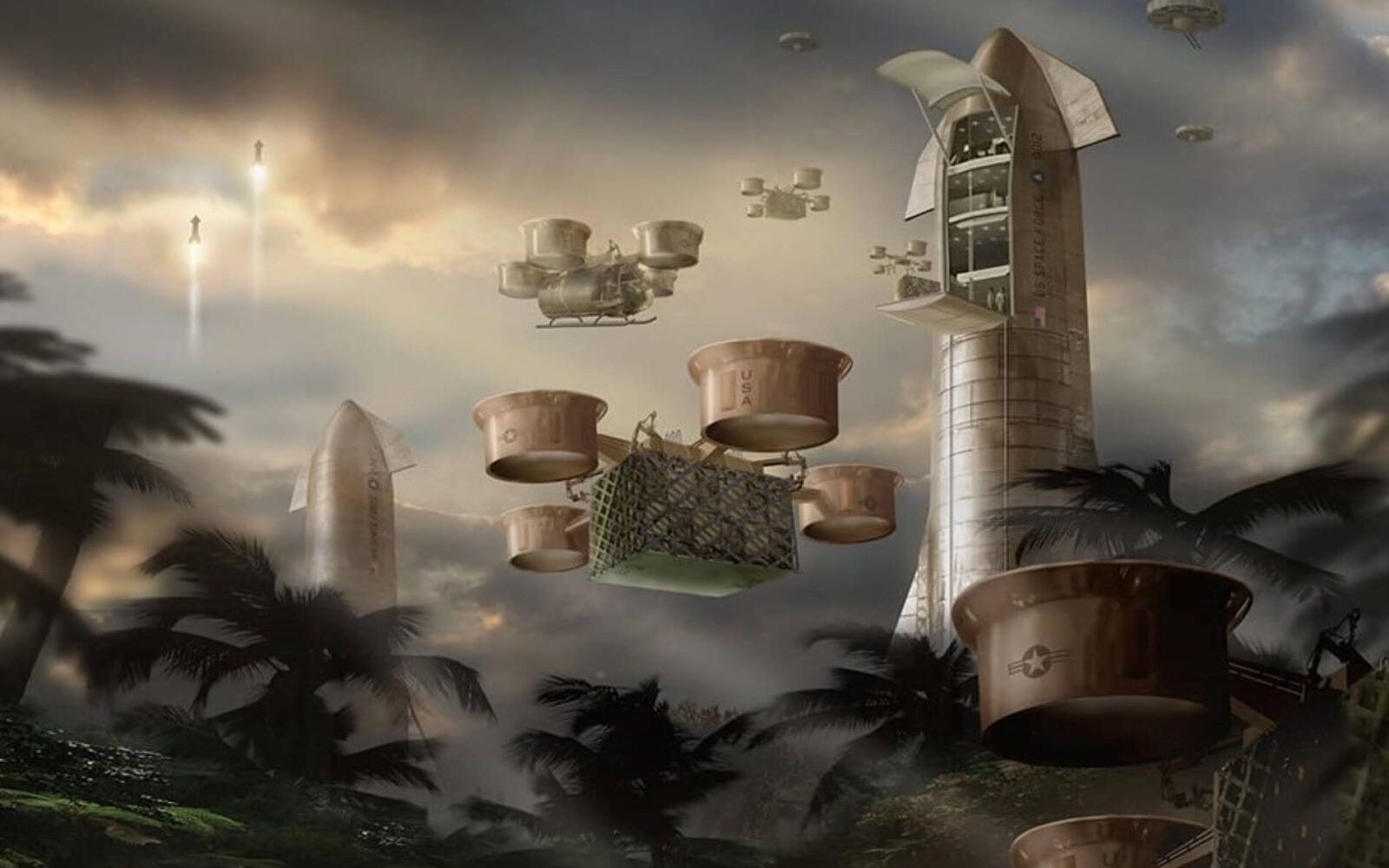
Starship Earth-to-Earth
First announced on the eve of the “modern” Starship era, Earth-to-Earth, or point to point travel, has been a back-burner staple of the Starship program since it’s been called Starship. At IAC 2017 Musk pitched the idea in typical fashion: simple in principle, insanely hard in engineering. Well, yes, if you’re flying a fully reusable Starship dozens of times a day, why not offer point-to-point, several times the speed of sound, breakfast in New York, lunch in Tokyo.
Like Tesla’s Full Self Driving in its early days, the idea got a pat on the back and a few nods, but nobody really thought it would happen in any real timeframe. Nobody but the Department of Defense that is.
Uncle Sam’s Interest
About three years after Musk’s announcement, while Starbase was still just a sandbar in South Texas, U.S. Transportation Command signed a Cooperative Research and Development Agreement with SpaceX to study point to point space transport of materiel.1
They hoped for a demo by 2021. Which of course, didn’t happen, but 2021 did give us the first successful flip and burn landing with SN10. That was enough progress to keep the Pentagon interested.
In 2022 the Air Force, ostensibly satisfied with the pace of progress, awarded SpaceX $102 million to continue developing the concept, aiming for a demo in the mid 2020s.2 The years following this contract award saw Starship’s focus shifted toward proving the full stack. For a while P2P looked like a stretch goal that would only come much later.
Then in early 2025, during the Starship doomer era, the Air Force announced it was starting environmental studies for Pacific landing sites.3 Suddenly the idea was back on the table, not just on the slides of a Starship presentation, but as an actual Air Force contract.
This is huge because an Environmental Impact Statement, or EIS, signals the Air Force is spending time and money to plan real landing zones, showing their confidence in the progress made towards not only an operational Starship stack, but also the work SpaceX has made towards P2P independently.
EISs usually take a while. The median is about two years, though defense projects can move faster. The one for SLC-37’s Starship pad wrapped in roughly 18 months. Though the Johnston Atoll EIS has already run into problems, The Air Force recently put the EIS on hold in response to conservationists wishing to leave the now bird sanctuary on the atoll, undisturbed, the rocket cargo program remains in progress as the Air Force searches for other viable landing sites.4
Any delay in completing the EIS adds directly to the overall timeline, as construction of landing facilities (more than likely something closer to the suborbital pads than a catch tower) cannot start until after there is a finding of no significant impact or mitigated finding of no significant impact issued.
So no, you will not be booking New York to Tokyo tickets any time soon. But a military cargo test in the next couple years is still plausible.
The Fun Begins
Up to now everything has been concrete: contracts, government announcements, environmental studies. The fun starts when you think about operational capability.
Eighty to a hundred tons of cargo. Anywhere on Earth. In about 90 minutes.
The best analog is the C-17 Globemaster, the same aircraft DoD uses as its yardstick in both contracts Starship P2P is involved in. A C-17 can carry about 77.5 tons with around 550 cubic meters of bay volume. Starship’s pressurized volume is closer to 1,000 cubic meters. In a conservative troop plus cargo configuration you could fit about 150 soldiers, roughly 20 tons of kit, plus around 40 tons of cargo. Essentially a C-17 but traveling at Mach 25. This is only the begining however. Starships Massive Payload volume, nearly double that of the C-17 means that Starship’s capability for both troops and cargo may well exceed that of the C-17.
Within two years the U.S. could have the ability to drop a C-17 or two worth of people and materiel anywhere on the planet in under two hours. That is a battlefield-leveling capability.
When I say troops, who do I mean? we cant just place any average 11B infantryman in a Starship cargo bay and expect them to leave Florida and land in Asia and come out guns blazing, no we need something elite, the Spaceborne. The obvious inspiration here is The Airborne. The Airborne being America’s existent rapid deployment corps, naturally The Spaceborne would be the next evolution of this; pairing an elite force with Starship’s speed feels inevitable. They would be America’s fastest deploying corps, capable of touching down on the other side of the globe minutes after launch. It sounds like science fiction but it is much, much closer than most, if any, realize.
Caveats
It is not all rainbows and Raptors.
First, there is no exfil. It is a one way trip, not unlike the paratroopers at Normandy. Unlike a parachute however, you cannot fold a 165 foot, 5,000 ton rocket and shove it into the bushes. Once Starship lands, it becomes the biggest target on the battlefield. Its arrival would already have been announced by sonic booms and Raptor engines, engines that shook every window in a 5-mile radius.
Then there is survivability. While hypersonic during cruise, the belly flop descent is slow and predictable. Any peer adversary with SBIRS satellites will know where and when it is coming down. Surprise insertions behind enemy lines are unlikely.
That does not kill the idea, though, it does confirm P2P Starship is not exactly a stealth tool but that it is a ludicrous logistics accelerator. Moving materiel that once took hours could now take less than one. Base to base, pad to pad, you have essentially built a highway with a speed limit of Mach 25. This is where Starship P2P shines.
Conclusion
Starship Earth to Earth is not dead. It may not put civilians on a breakfast in New York, lunch in Tokyo schedule any time soon, but demonstration flights for military use are likely before the decade is out, maybe as soon as 2027.
That means the strategic implications are not far-off speculation. They are something military planners need to think about now.
https://www.dla.mil/About-DLA/News/News-Article-View/Article/2399933/us-transportation-command-considers-next-steps-for-potential-space-logistics/
https://www.space.com/spacex-air-force-102-million-dollar-contract-rocket-transport?utm_source=chatgpt.com
https://www.federalregister.gov/d/2025-03359
https://www.space.com/space-exploration/launches-spacecraft/u-s-air-force-cancels-plans-to-build-starship-landing-pads-on-island-bird-sanctuary